


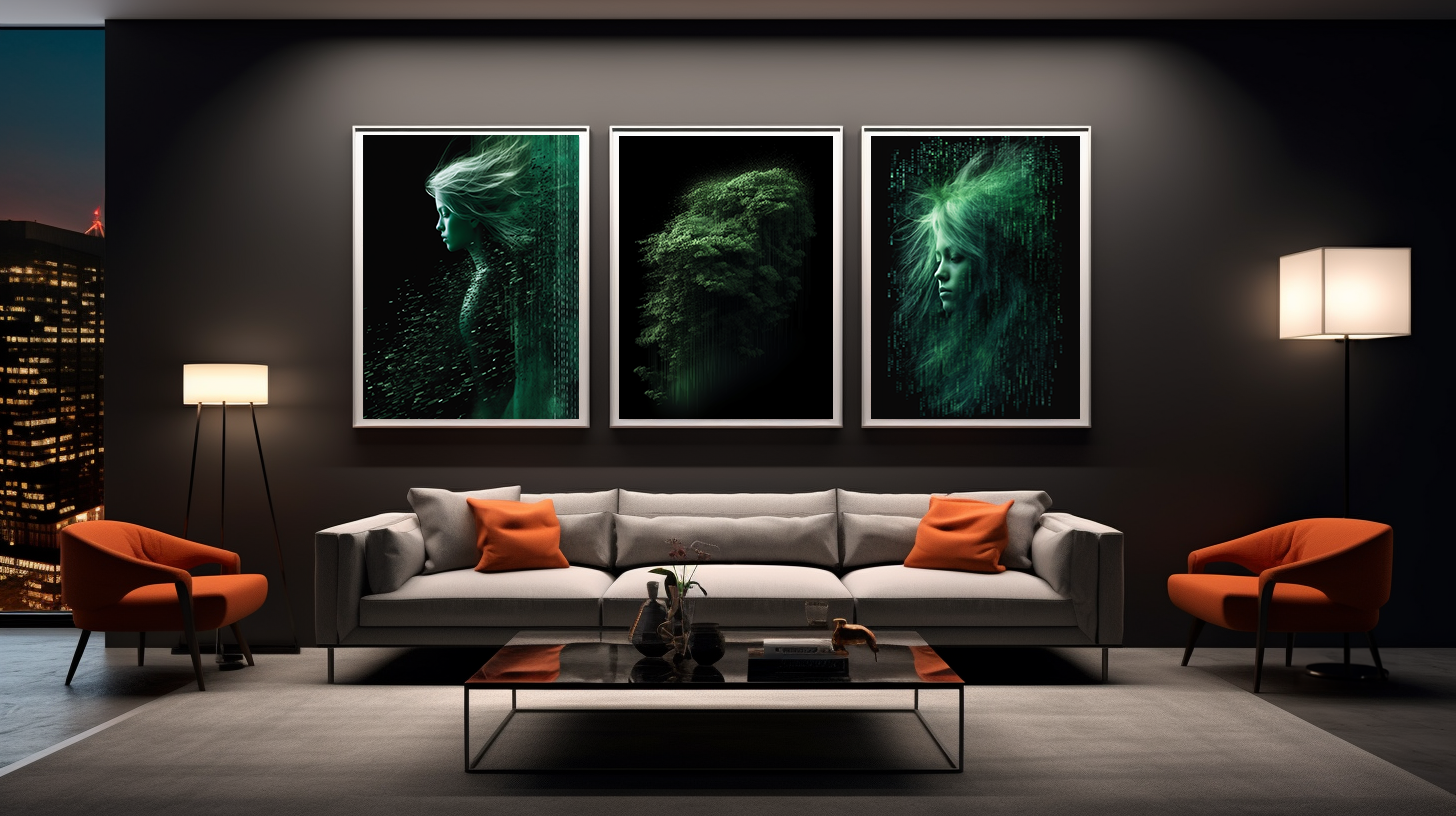
Short answer: to choose wall art, pick one piece about two-thirds the width of the furniture or wall below it, then hang it so the centre sits around 145 to 155 cm from the floor, roughly eye level. Go larger rather than smaller, keep one clear focal point per wall, and match the finish to your light. The sections below cover size, height, framing, gallery walls, and care.
What size wall art should you choose?
As a rule, a single piece should fill about two-thirds of the width of the furniture or the wall space beneath it. Most rooms read better with one larger piece than several small ones scattered around, so when you are unsure, size up. Use the quick guide below as a starting point, then check the exact sizes available for any piece on its product page.
| Where it hangs | A good size to aim for |
|---|---|
| Above a sofa, bed, or console | About two-thirds the width of the furniture, centred |
| A narrow wall or alcove | One upright piece filling most of the wall’s width with margin around it |
| A large empty wall | One oversized piece, or a planned grouping, covering roughly 60 to 75 percent of the wall |
| A desk or reading nook | A smaller piece kept within the width of the furniture below |
Every Hive Arts Studio product page lists the sizes available on Art Heroes, so you can match these proportions to a real size.
How high should you hang wall art?
Hang art so its centre sits about 145 to 155 cm from the floor, which puts the middle of the piece near average eye level. This is the same height galleries use, and it keeps art from drifting too high, the most common hanging mistake. When a piece hangs above furniture, leave roughly 15 to 20 cm between the top of the furniture and the bottom of the frame so the two feel connected rather than separate.
In a room where you are mostly seated, such as a home office or a reading corner, you can lower the centre slightly so the piece meets you at seated eye level.
Framed or unframed: which should you pick?
Both work well; the right choice depends on the room and the look you want. Framing adds a finished, gallery feel and protects the surface, while an unframed print or canvas reads cleaner and more contemporary and is lighter to hang. The comparison below sums it up. Material and framing options vary by piece, so confirm what is offered on the product page before you order.
| Framed print | Unframed print or canvas | |
|---|---|---|
| Look | Finished, formal, gallery feel | Clean, contemporary, lighter on the wall |
| Protection | Glass or acrylic shields the surface | More exposed, simpler to swap out |
| Weight and hanging | Heavier, needs a secure fixing | Lighter, easy to hang and move |
| Best for | A living-room statement or a calm bedroom anchor | Home offices, gallery walls, and rented spaces |
How do you arrange a gallery wall?
A gallery wall works when it feels intentional rather than busy. Keep every piece within one palette or one theme so the group reads as a set, align either the tops or the centres of the frames, and leave a consistent gap of about 5 to 8 cm between them. Plan the layout on the floor first, or cut paper templates and tape them to the wall, before putting a single nail in.
If a gallery wall feels like too much, the simplest and cleanest option is a single large anchor piece with calm wall space around it. One strong focal point almost always looks more considered than a crowd of small frames.
How do you keep art prints looking good?
Keep prints out of direct, sustained sunlight, which is the main cause of fading for any artwork over time, and avoid hanging them where they take daily moisture, such as directly above a radiator or in a steamy bathroom. A matte or satin finish helps in bright rooms because it cuts the glare from windows, lamps, and screens.
For the specific paper, finish, and longevity of a given piece, check its product page, since printing and materials are handled by the studio’s print partner, Art Heroes.
Which piece fits your space?
Once you know the size and height, the easiest way in is by room. Each guide below pairs real Hive Arts Studio pieces to a setting with placement notes.




Prefer to browse by style? Explore the Abstract, Surrealism, Sci-Fi, and Fashion collections, or see All Works.
Choosing and hanging wall art: FAQ
What size art should hang above a sofa?
Aim for a piece about two-thirds the width of the sofa, centred above it. One larger piece reads calmer and more deliberate than several small ones. Each product page lists the sizes available so you can match this proportion.
How high should I hang wall art?
Hang it so the centre of the piece is about 145 to 155 cm from the floor, near eye level. Above furniture, leave roughly 15 to 20 cm between the top of the furniture and the bottom of the frame.
Are framed or unframed prints better?
Neither is better outright. Framing gives a finished, protected, gallery look, while unframed prints and canvases read cleaner and are lighter to hang. Choose by room and budget, and confirm the options offered on the product page.
Do art prints fade over time?
Any print can fade if it sits in direct, sustained sunlight. Hang pieces away from strong daily sun and moisture, and a matte or satin finish helps in bright rooms. Check a piece’s product page for its specific materials.
How do I start a gallery wall?
Keep every piece within one palette or theme, align the tops or centres, and leave a steady 5 to 8 cm gap between frames. Lay the arrangement out on the floor or with paper templates before you hang anything.
Find the piece for your wall
Now you have the sizes and the height, choose an original that fits your space.